How to study in nursing school: a weekly method built on how memory works
By Roupen Odabashian, MD, FRCPC · Published · 17 min read
How we write and check articles: Editorial Policy.
Disclosure: Alma publishes this article and makes one of the study tools it discusses.
How to study in nursing school: a weekly method built on how memory works
If you are rereading notes, memorizing drug lists and still missing “what should the nurse do first?” questions, your problem is likely the method, not your effort. The best way to study for nursing school is a simple weekly loop: learn a little, test yourself often, and space it out over time using tools that fit your schedule. This guide walks through that loop, shows you a realistic study week, and points out where AI study tools help without replacing NCLEX-style practice.
This article is for BSN and ADN students in their first year, plus pre-nursing students who want a realistic plan before they start.
Why does nursing school feel so different from prerequisites?
Nursing school feels harder partly because the old tricks (cramming, rereading, highlighting everything) don’t match what your exams ask you to do. Evidence from cognitive psychology shows that passive techniques like rereading and highlighting add little to performance, while practice testing and spaced practice help across ages and subjects.[1][2] Nursing exams also layer clinical judgment on top of basic facts, which adds load compared with prereq multiple-choice tests.

In anatomy or microbiology, you could sometimes get away with memorizing definitions the night before. In nursing school, you still need those facts, but you must use them to decide priorities, safety risks and teaching points in a changing scenario. That shift exposes weak study habits very quickly. If you want a frank look at which courses and clinical demands trip students up, see how hard nursing school really is and how to handle the hardest parts.
Cognitive psychology research reviewing common techniques found that:
- Practice testing (self-testing with questions or flashcards) and distributed practice (spacing your review over time) were rated “high utility” because they help students of many ages and abilities and improve performance on many types of tasks.[1][2]
- Rereading, highlighting, summarizing and imagery for text were rated “low utility” because they are hard to use well and often give inconsistent gains.[1][2]
So if you feel like you are working all the time and still not seeing results, you are not alone. The fix is to shift from time spent with the material to how you interact with it: more retrieval, more spacing, less passive reviewing.
Memorizing vs understanding: what are nursing exams really testing?
The NCLEX is built to measure clinical judgment, not just recall,[3][4] and many nursing programs write their unit exams in the same NCLEX style. These exams ask whether you can recognize what matters in a situation, interpret data and decide on safe, effective actions. That means you must study in a way that connects facts to decisions, not just memorize lists.

The organization behind the NCLEX uses the Clinical Judgment Measurement Model (NCJMM) as a framework for building questions that measure clinical judgment and decision making in a standardized exam.[3] In that model, one layer specifically describes the cognitive processes nurses use to make decisions, and these processes guide development of NCLEX case studies and items.[3][4]
Translated into day-to-day study, that means:
- Knowing normal values and drug actions is necessary, but not sufficient.
- You also need to practice recognizing patterns, prioritizing patients, and selecting the next best action.
- Simply copying notes or watching lectures will not give you enough practice with those decisions.
A good nursing study method keeps both layers in view: it builds a foundation of facts and constantly forces you to apply them in NCLEX-style thinking.
What weekly study loop actually works in nursing school?

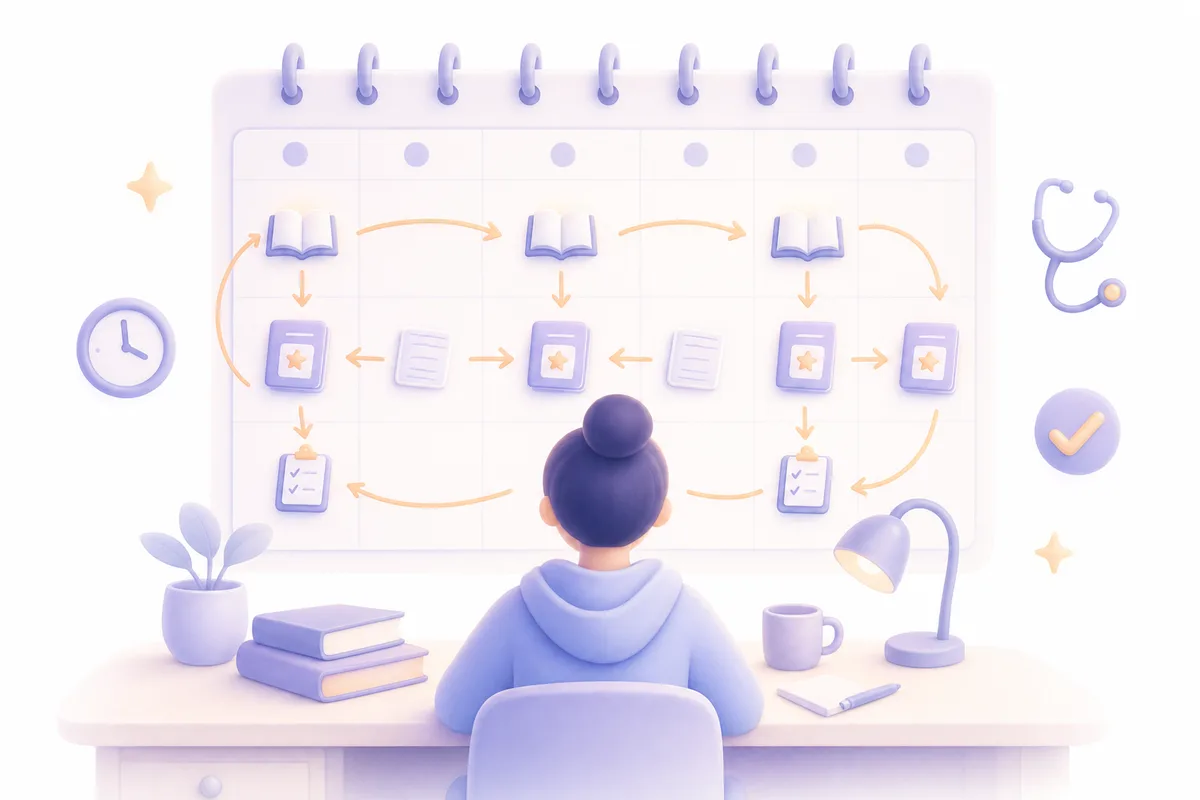
Here is a before–during–after lecture checklist that puts that research into a concrete loop.
Before lecture: how should nursing students prepare?
Before-class work should be short and focused. The goal is to give your brain a map of the topic so lecture feels like filling in details, not hearing words for the first time.
- Skim the assigned reading for headings, bold terms and summary tables (10–20 minutes).
- Write 3–5 questions you expect the lecture to answer, such as “What are priority assessments for heart failure?”
- Create or open a note page for that lecture with space for “Key concepts,” “Nursing actions,” and “Questions.”
During lecture: how do you take notes that help later?
During lecture, your job is to process, not transcribe. Because rereading and highlighting have low utility when used alone,[1][2] the way you write notes should set you up for later retrieval.
- Listen for patterns: “most important,” “safety,” “NCLEX-style,” “this always shows up.” Mark these with a star.
- Capture examples and rationales, not just bullet lists. For each concept, try to write at least one “because” sentence.
- Leave space in the margin to write your own questions later.
After lecture (same day): what should you do in the first 24 hours?
Make your first review after lecture a retrieval session. In one study, students who learned a word list mostly by recalling it remembered more a week later than students who mostly restudied it, even though both groups had the same number of learning trials and the recall group studied the list only a third as many times,[5] so your first step is to retrieve from memory, not reread.
Soon after lecture:
- Close your notes and write a short “teach-back” paragraph about the topic from memory.
- Turn the strongest points into a small set of flashcards or questions.
- Test yourself once on those cards or questions.
Later in the week: how often should you review?
Spacing your reviews over days and weeks matters. A large review of distributed practice found that learning tends to improve when study is spaced out, and that longer intervals between study sessions often help retention when the final test is farther away.[6] In practice:
- Plan at least two short review sessions for each lecture later in the week (for example, Wednesday and Saturday for a Monday class).
- Use those sessions for flashcards and practice questions, not rereading.
- Mix topics (“interleave”) instead of finishing one unit completely before touching another.
How do you answer NCLEX-style questions on unit exams?
NCLEX-style questions are built to test the cognitive side of clinical judgment, not just memory.[3][4] They present a situation and ask what the nurse should do, often with several partially correct options. To improve at these, you must practice thinking with the same framework used to build the questions, and always link actions back to safety and priorities.
The NCJMM describes layers of a clinical situation, from broad context down to specific cognitive steps, and it guides how NCLEX case studies and questions are developed.[3][4] For exams, that translates into questions built around the six clinical judgment steps named in the NCLEX-RN test plan:
- Recognizing cues (which data matter?)
- Analyzing cues (what do they mean together?)
- Prioritizing hypotheses (which problems are most urgent?)
- Generating solutions, taking action and evaluating outcomes (which action is best, and did it work?)
When you practice questions, train yourself to walk those steps explicitly:
- Identify the stem’s core problem. Ignore fluff. Ask, “Which patient problem is this really about?”
- State the safety issue. Think airway, breathing, circulation, and immediate risk.
- Eliminate actions that assess after obvious danger, delegate inappropriately, or ignore key cues.
- Choose the option that addresses the highest-priority problem earliest.
This reasoning is more like clinical judgment than trivia, so be patient with yourself. It usually takes weeks of consistent practice questions and review of rationales before your instincts match what exams expect. Closer to graduation, how to build a 4, 6 or 8 week NCLEX-RN study plan shows how to carry these habits into licensure prep.
How should you study from lecture slides and textbook PDFs?
Lecture slides and thick textbooks can drown you in details. Instead of trying to memorize everything, treat them as source material for active practice. Because summarizing and rereading alone are low-utility techniques,[1][2] your main tasks with slides and PDFs are to extract high-yield points, turn them into questions and cards, and connect overlapping concepts.
Here is a practical workflow if your course posts slides or readings as PDFs:
- Work through the PDF one section at a time and write down the two or three points each heading or group of slides is really teaching.
- Turn each point into a question you could be asked on an exam, ideally a “what should the nurse do” question rather than a definition.
- When two lectures cover the same idea (fluid balance in patho and in med surg, for example), put them on the same page or card so you review them together.
If you would rather not write every question by hand, Alma’s Learning Hub can turn a lecture PDF you upload into a quiz, an editable slide deck and a mind map, with quiz questions drawn from your own file. How Alma turns your lecture PDFs and notes into quizzes, slides and mind maps shows each step. Check generated questions against your slides, as you would with any AI tool.
For a more detailed PDF-based method, see the walkthrough in how to study from a textbook PDF with AI in medical, nursing and PA school.
What kind of flashcards actually help in nursing school?
Here are principles for nursing flashcards:
- Make cards about decisions and relationships. Example: “A client on furosemide reports muscle weakness and irregular pulse. Which electrolyte imbalance is most likely and what is the first assessment?”
- Limit pure fact cards to things you truly must recall exactly (core lab values, black box warnings, insulin types).
- Include rationales on the back. A quick “because” sentence forces understanding.
- Mix question formats. Short scenarios, “which action first,” and “what finding do you expect” cards better match exam thinking.
Whether you build cards by typing them, generating them from notes, or capturing them from a PDF, treat the AI-generated text as a draft: skim every card before adding it to your deck, because no AI model should be trusted blindly for medical content.
Once the cards exist, the schedule matters as much as the wording. Alma’s Flashcards schedule reviews with FSRS (Free Spaced Repetition Scheduler), an open-source algorithm that predicts when your recall of each card will drop to a target level and books the review for that day. A Due Today count at the top of your deck list shows what to review now. How Alma uses FSRS to schedule your flashcards explains the Again, Hard, Good and Easy buttons and what the intervals mean.
What is a realistic study week for a busy nursing student?
Most nursing students need many hours of study each week, but research on learning techniques shows that how you study shapes how much those hours pay off.[1][2] A common planning rule is two to three hours of study outside class for every hour of lecture each week,[7][8] but treat that as a starting point, not a prescription. A part-time job, commute and family responsibilities all affect what is realistic for you.
Here is a sample week for a full-time student who also works two evening shifts. Adjust the times, but try to keep the pattern: short daily retrieval, spaced reviews and mixed practice.
| Day | Morning | Afternoon | Evening |
|---|---|---|---|
| Monday | 30 min preview + 2 hr lecture | 45 min same-day retrieval (teach-back, flashcards) | Work shift; 20 min light cards before bed |
| Tuesday | 30 min cards from yesterday + 30 min practice questions | 2 hr pharm lecture | 45 min pharm flashcards and quiz review |
| Wednesday | 60 min mixed cards (all courses) | Lab/clinical prep 1 hr | Work shift; off-study after |
| Thursday | 30 min quick review of weakest topic | 2 hr med surg lecture | 45 min med surg practice questions + rationales |
| Friday | 60 min cumulative cards (week’s lectures) | Optional group review 1 hr | Evening off |
| Saturday | 2 hr focused exam prep (mixed questions) | 1 hr notes clean-up and card creation | Off |
| Sunday | 90 min gentle review (cards, skim notes) | 30 min plan next week’s blocks | Off |
How should you study for Fundamentals, pharm, med surg and patho?
Different courses stress different blends of memorization and judgment, but the same retrieval-and-spacing loop applies. The main difference is what you put on your cards and questions.
Fundamentals
Fundamentals is where you learn safety, basic procedures and the language of nursing. Exams often emphasize patient safety, communication and basic prioritization.
- Focus your flashcards on core safety principles, infection control and standard precautions.
- Practice questions that involve delegation, scope of practice and first actions when something seems unsafe.
- In lectures, highlight any example where a nurse speaks up or clarifies an order; those are patterns exams like to test.
Pharmacology
Pharm feels memorization-heavy, but judgment still matters, especially around adverse effects and teaching.
- Group drugs by class, not alphabetically. Make cards that ask for class mechanism, key side effects and critical teaching points.
- Use spaced repetition aggressively for lab values, interactions and high-risk meds.
- Practice questions that ask “which statement by the client indicates a need for further teaching?” so you link facts to counseling.
- Practice dosage calculations a little every week instead of only before a math exam; these dosage calculation practice problems with worked answers cover tablets, liquids, weight-based doses and IV rates.
Med surg
Med surg is where clinical judgment ramps up. You will see lots of scenarios where several answers look partly right.
- Build scenario-based cards that ask for expected findings, priority assessments and first interventions.
- Practice NCLEX-style questions frequently, reviewing rationales even when you are correct to strengthen your reasoning.
- Draw a quick mind map for each major condition that links its pathophysiology, key assessment findings and priority nursing actions, so you can see how concepts connect across chapters.
Pathophysiology
Patho links underlying mechanisms to clinical signs. Understanding here pays off in every other course.
- Use diagrams and mind maps to connect cause, chain of events and manifestations.
- Make flashcards that ask, “In condition X, what happens to Y and why does that cause symptom Z?” rather than just naming definitions.
- Quiz yourself on pathways weekly, not only before exams, because this content underpins med surg and pharm questions later.
How do you know when your nursing study method is not working?
Even a good plan needs adjustment. Because practice testing and distributed practice are high-utility techniques,[1][2] a method that does not leave time for them (for example, wall-to-wall rereading) is unlikely to hold up on exams. Watch for these signs you should change something:
- You are spending most evenings “reviewing notes” but rarely doing practice questions.
- Your exam scores lag your practice questions by a lot, suggesting your practice is easier than the test.
- You forget material within days unless you cram again.
- Your stress spikes before every exam because you have no clear plan for what to review.
If you see several of these, start small: swap one hour of rereading for one hour of mixed practice questions with rationales, and begin making 5–10 new flashcards after each lecture instead of copying notes. Over a few weeks, move more of your total time toward retrieval and spacing.
Frequently asked questions
How many hours a week should I study in nursing school?
There is no magic number that fits everyone. In the U.S., the federal definition of a college credit hour assumes at least two hours of out-of-class work each week for every hour of classroom instruction,[7] and some nursing programs tell students to plan two to three hours of outside work per credit hour.[8] For 8 credits of lecture courses, that works out to roughly 16 to 24 hours a week. Your needs will vary with course load, background and how efficiently you study. Use hours as a rough planning tool, but judge your method mainly by whether you can answer NCLEX-style questions and explain concepts without your notes.
Is rewriting notes or rereading useful?
Rewriting or rereading can help you feel familiar with the material. Rewriting notes was not among the ten techniques in the large review cited here, but rereading was rated low utility because it does not consistently boost performance.[1][2] They are most helpful when paired with active methods: for example, quickly skimming notes to refresh your memory, then closing them and doing flashcards or practice questions.
How do I move from memorizing facts to answering “what should the nurse do first?”
First, make sure you actually know the core facts (like normal values and key adverse effects). Then spend most of your study time on NCLEX-style questions and scenario-based flashcards that force you to decide on a priority action. Use the NCJMM steps as a mental checklist: recognize important cues, interpret what they mean together, decide which problem matters most, and then pick the safest, most direct action.[3][4]
How do I study when there is more content than I can cover?
When content feels overwhelming, you cannot cover every line equally. Use class objectives and instructor emphasis to identify high-yield topics, then devote your practice testing and review time to those. Because practice testing has been rated as a high-utility technique that benefits learners of different ages and abilities across many kinds of outcome measures,[1][2] even short, focused sessions on key areas are better than shallowly touching everything once.
Should I use premade Quizlet decks or make my own flashcards?
Premade decks can save time, but they may not match your course’s emphasis, and they can lull you into recognizing answers rather than recalling them. Making your own cards from lectures and textbooks makes you work through the material, and quizzing yourself with those cards is practice testing, which the research rated high utility.[1][2] A reasonable compromise is to skim premade decks for ideas, but spend your main effort building and reviewing cards that come directly from your own notes and readings, ideally scheduled with a spaced-repetition system.
If you would rather not plan every review block by hand, Alma’s Study Schedule can build a day-by-day plan from your exam date, the hours you can study each weekday, your days off and your weaker topics, and you can drag and edit any block. Its Insights page then shows a “Do this now” card that picks one weak topic and opens flashcards on it, which keeps the retrieve-and-space loop running between exams. Alma is not a question bank, so keep working NCLEX-style practice questions alongside it.
References
- Improving Students’ Learning With Effective Learning Techniques - Psychological Science in the Public Interest - APS
- Improving Students’ Learning With Effective Learning Techniques: Promising Directions From Cognitive and Educational Psychology – Association for Psychological Science – APS
- Clinical Judgment Measurement Model | NCLEX
- NCSBN. Leader to Leader, Fall 2019: NCSBN defines clinical judgment for purposes of the Next Generation NCLEX (NGN)
- Karpicke JD, Roediger HL. Repeated retrieval during learning is the key to long-term retention. Journal of Memory and Language. 2007;57:151-162. doi:10.1016/j.jml.2006.09.004
- Cepeda NJ, Pashler H, Vul E, Wixted JT, Rohrer D. Distributed practice in verbal recall tasks: a review and quantitative synthesis. Psychological Bulletin. 2006;132(3):354-380. PubMed
- Electronic Code of Federal Regulations. 34 CFR 600.2, Definitions: Credit hour. U.S. Department of Education
- Donnelly College Nursing Program. Nursing Student Handbook 2025-2026: Time Commitment and Expectation