AI cartoon mnemonics and images for medical flashcards: when to use them and how Alma fits
By Roupen Odabashian, MD, FRCPC · Published · Last updated · 17 min read
How we write and check articles: Editorial Policy.
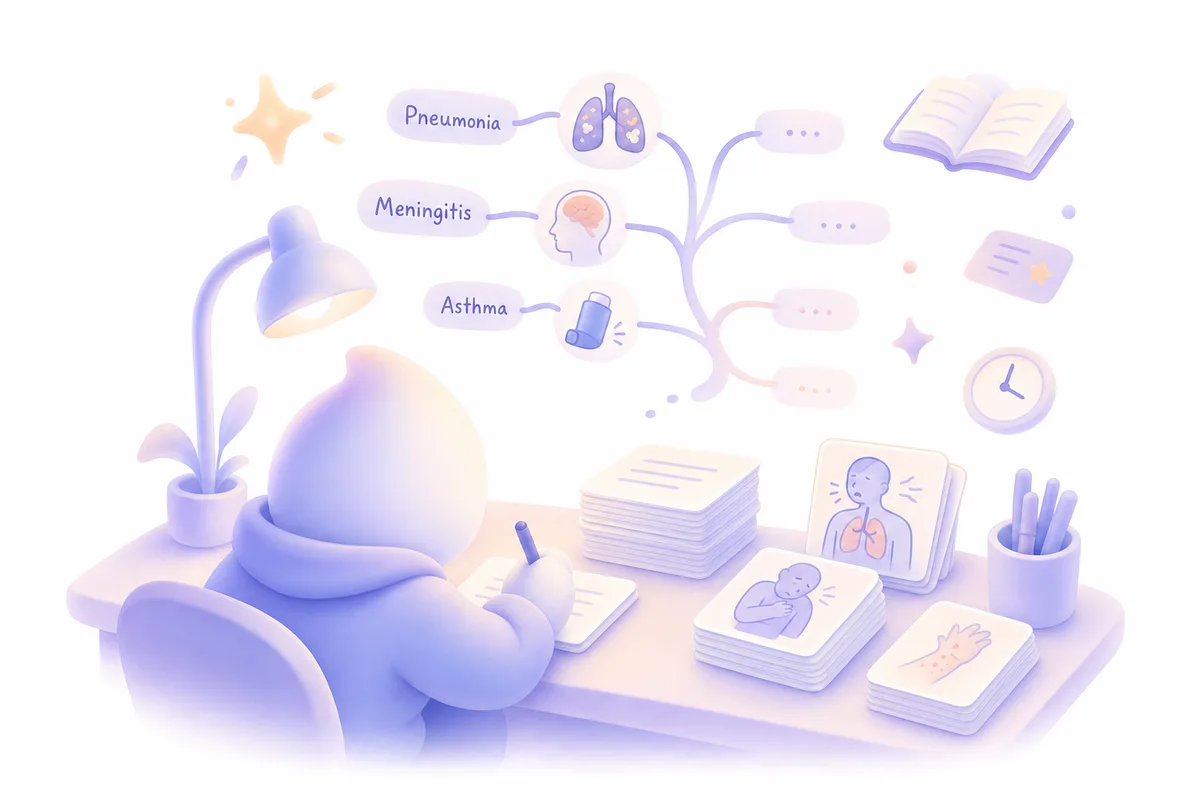
Disclosure: Alma publishes this article and makes one of the study tools it discusses.
If you are in medical school and wondering whether to add AI drawn pictures to your medical flashcards, the short answer is that visuals can help you understand and remember material, but only when they are simple, accurate and tied to retrieval practice. Visual platforms like Sketchy and Picmonic build entire courses around this idea.[1][2] Alma sits in a different spot: it lets you turn your own text into AI images and picture backed flashcards, then schedules those cards with spaced repetition. The right choice depends on whether you want a full visual curriculum or visual support built from your own notes.
This article walks through when pictures actually improve recall, what AI image tools are good and bad at, how Alma’s Notebook image generation and flashcard pictures work, and how that compares honestly with Sketchy and Picmonic. We will stay concrete so you can decide if “medical flashcards with pictures” should be central in your workflow or just one more tool on the side.
What are medical mnemonic flashcards with pictures trying to solve?
Medical mnemonic flashcards with pictures try to make dense, abstract facts easier to remember by turning them into concrete images and stories. Research on visual learning and mnemonics finds that people often remember pictures and image based associations better than text alone, especially when visuals and words are combined thoughtfully.[3][5][6]

Visual learning uses images, diagrams and videos to convey information, and students tend to organize and process information more thoroughly when they learn visually.[3][5] Studies summarized in reviews of visual learning suggest that combining visual and verbal information can improve retention, reading comprehension and higher order thinking compared with words alone.[3][5]
This does not mean that people are fixed “visual learners”. The evidence does not support matching teaching to a learning style, and students benefit most from mixed formats that combine pictures and words.[5]
Mnemonics are devices that rely on elaborative encoding, retrieval cues and imagery, and Wikipedia's overview notes that people tend to remember spatial, surprising, humorous and otherwise relatable information more easily than abstract facts.[6] Image mnemonics in particular construct information into a picture that allows the mind to connect concepts through visual associations.[6] For medical students, who face heavy loads in subjects like microbiology, pharmacology and anatomy, these approaches promise a way to anchor long lists of mechanisms, bugs and drugs to something more memorable.
The key is not that pictures are always better, but that they can free up working memory by offloading certain relationships or categories into a visual scene. That can make recall quicker and more reliable during exams, if you have done enough active retrieval practice on top of just watching or viewing the images.
How do Sketchy and Picmonic use visuals for medical students?
Sketchy and Picmonic are purpose built visual study tools that turn medical topics into narrated images, symbols and built in quizzes. Sketchy focuses on full sketch based lessons and interactive cases for med students, while Picmonic builds short picture mnemonics with spaced repetition. Both go beyond static pictures by pairing visuals with retrieval practice and explanation.[1][7][2][4]

What does Sketchy offer for medical school visual learning?
Sketchy turns medical concepts into recurring symbols and story based sketches, then reinforces them with quizzes and clinical cases.[1][7] For many medical students this can serve as a core resource in preclinical and early clinical years, especially in micro and pharm heavy courses.[1][7]
According to Sketchy’s medical program page, the platform offers the following structure for med students as of October 2026:[7]
| Sketchy component | What it includes | Citation |
|---|---|---|
| Visual lessons | 1,300 plus high yield lessons using recurring symbols and themes, with quizzes after each lesson | [7] |
| Interactive cases | 405 plus interactive patient cases that simulate clinical decisions and lab or imaging interpretation | [7][8] |
| QBank | 9,850 plus vignette style questions with explanations linked back to the sketches | [7][8] |
Sketchy emphasizes that learners can review clickable symbols from lessons as visual flashcards to build a “visual memory bank”.[1] The platform describes its method as helping students learn and retain medical concepts faster by turning dense material into stories and quirky symbols that “stick”.[1] Sketchy markets that 9 in 10 students score higher on exams with Sketchy,[7] and its homepage says 96 percent of students who use it report higher exam scores.[1] These are Sketchy's own marketing claims, and the 96 percent figure is self reported, so treat them as one input among others when planning your study stack. Its homepage also describes the library more loosely as thousands of lessons and 400+ cases, so counts differ by page.
Pricing for Sketchy's medical program is subscription based. Its medical page listed these list prices when we checked on October 20, 2026, and a sitewide sale was running, so the price you see may differ:[7]
| Plan length | Approximate monthly cost | Total cost | Citation |
|---|---|---|---|
| 6 months | $58.33 per month | $349.99 total | [7] |
| 12 months | $37.49 per month | $449.99 total | [7] |
| 24 months | $27.08 per month | $649.99 total | [7] |
Sketchy offers a free trial with no credit card as of the date the vendor published that claim, so you can test whether the visual style clicks for you.[1] The main upside of Sketchy for visual learners is that the creative metaphor work is already done. The tradeoff is cost and the need to fit your school’s curriculum into their sequence of lessons rather than building directly on your lecture slides or syllabus.
What does Picmonic provide with visual mnemonics and flashcards?
Picmonic is another visual mnemonic study tool that turns topics into short, humorous picture stories with built in quizzes and spaced repetition. It targets medicine, nursing and other health programs, with an emphasis on increased memory retention compared with text alone.[2][4]
Picmonic describes itself as an audio visual tool that converts the information students need to know into unforgettable images and stories that are scientifically designed to increase memory retention.[2] Its learning system uses picture mnemonics, interactive videos and built in quizzing to help learners “remember more in less time.”[2] The company cites what its page calls an IRB study, described as randomized, double blind and controlled, in which medical students using Picmonic improved long term memory retention by 331 percent and test scores by 50 percent compared with text based material after one week. It is a single 2014 study linked to Picmonic's own team and not independent evidence, so treat the numbers as vendor reported.[4]
Picmonic’s design draws on memory research concepts like the picture superiority effect and dual coding theory, which note that pictures are often better remembered than text and that visual and verbal information are processed through distinct channels in the brain.[4] Picmonic also includes a spaced repetition based daily quiz feature that surfaces facts at increasing time intervals when you recall them correctly and sooner when you miss them, aiming to counter the forgetting curve.[9]
For customization, Picmonic allows students to add their own facts or even create their own Picmonics to personalize the study experience.[2] It also offers create your own flashcards that support retrieval practice and spaced repetition within the TrueLearn platform, on the web only at the time of the help article.[10] As with Sketchy, vendor reported improvements are promising but you will want to test whether the specific humor and art style actually aid your recall and fit your time budget.
Where does Alma’s AI image generation fit for medical flashcards with pictures?
Alma has two picture tools, and both start from your own material. In the Notebook, you can turn selected text into an AI image, and the Notebook also supports mind maps, data tables and a knowledge graph. On flashcards, Alma can add a picture to a card in one of two styles, a textbook illustration or a cartoon mnemonic. Generating pictures is rate limited, so it makes sense to save them for the cards that really need one.
Alma flashcards also support image occlusion, where you hide parts of an image and quiz yourself on them, which suits anatomy, pathways and histology. Cards are scheduled with FSRS, so a picture card gets the same spacing as a text card.
These pictures are generated by AI on request, so they can be wrong. Check every picture against your lecture slides or an atlas before you trust it.

What does Alma not do compared with Sketchy and Picmonic?
Alma is not a curated visual curriculum. It has no library of pre drawn mnemonic lessons, no recurring cast of symbols and no video course like Sketchy or Picmonic, and its pictures are generated on request from your own text rather than designed by artists. Alma is also not a question bank of real exam questions. If you want a ready made visual course, Sketchy or Picmonic fit that job, and many students pair one of them with Alma for their own lecture material.
We have separate guides on how to combine tools safely and realistically, including an overview of AI tools for medical school and how Alma fits and a detailed look at Sketchy vs Picmonic vs Pixorize vs Boards and Beyond vs AI. This article stays focused on the specific question of medical flashcards with pictures.
When do images actually help your medical flashcards?
Images help medical flashcards most when they simplify complex relationships, support active recall and avoid visual clutter. Visual learning research suggests that combining pictures with words can improve retention and understanding, but that benefit depends on how well the visuals are designed and integrated into retrieval practice rather than used as passive decoration.[3][5]
Broadly, research on visual learning shows that students remember information better when it is represented both visually and verbally, and when they organize it using visual structures like diagrams or graphic organizers.[3][5] Reviews note improvements in retention, reading comprehension, achievement and critical thinking when visual methods are used alongside text.[5] Picmonic's cited study, which is vendor linked and dates from 2014, reported large gains in retention and test performance for medical students who used picture mnemonics compared with text alone, at least over a short horizon.[4]
Mnemonic overviews suggest that image based mnemonics can help, especially when they involve vivid, surprising or humorous associations, although much of the evidence cited here is general rather than specific to medical students.[6] Sketchy and Picmonic explicitly lean on these ideas by creating humorous, story driven scenes with recurring characters and symbols.[1][2]
In practical terms, images are most likely to help your flashcards when they do one of the following:
- Show relationships that are hard to keep in your head as text, such as pathways, anatomic spatial relationships or multi step processes.
- Provide a stable anchor for a cluster of facts, like bugs or drugs that share a mechanism or side effect profile.
- Act as quick cues rather than full explanations, so they speed up recall instead of slowing you down.
- Remain consistent across multiple cards, like a symbol that always represents a certain receptor or organism.
Alma's AI images from selected text, mind maps and flashcard pictures are best used in these cases, where you can turn a confusing explanation into a simple visual and attach it to a spaced repetition card. Sketchy and Picmonic can serve as external reservoirs of visual anchors if their art style works for you and aligns with the material you need to study.[1][7][2][4]
What are the limits of AI drawn anatomy and clinical images?
AI image generation has real limits for anatomy and clinical visuals. While it can produce helpful diagrams and symbolic scenes, it is not a substitute for authoritative atlases, imaging or histology, and AI can introduce subtle inaccuracies that matter in medicine. Any AI generated medical picture needs to be checked against reliable primary resources before you trust it.
None of the sources here claim that AI drawn anatomy is reliable enough for clinical decision making, and Alma is not a clinical decision tool. Visual learning research supports diagrams and images as aids to understanding and retention, not as diagnostic references.[3][5] AI drawn figures are best treated as custom visual mnemonics: ways to encode relationships you already understand from trustworthy sources, not ways to learn detailed anatomy or pathology from scratch.
Particular risks include mislabeled structures, distorted spatial relationships and oversimplified pathophysiology. These might be acceptable for a personal memory aid if you clearly know where the simplification lies, but they can be harmful if you internalize them as literal anatomy or real imaging findings. When you use Alma’s AI images for anything anatomical or clinical, you should compare the result against your official atlas or lecture slides and adjust your text prompt or the diagram if needed.
For that reason, AI images are strongest for abstract or semi abstract content like pathways, classification trees, mechanisms and quick symbolic cues. For detailed anatomic study, traditional atlases and vetted resources should remain your primary guides, with AI diagrams as supplementary organizers rather than replacements.
How should you decide between Alma, Sketchy and Picmonic for visual study?
The right mix depends on your budget, your need for a full visual curriculum vs support for your own notes, and how much you like a vendor's art style. Sketchy and Picmonic supply curated visual courses and mnemonics.[1][7][2][4] Alma focuses on transforming your materials into AI images, flashcards, mind maps and other active recall tools with spaced repetition.
Here is a high level comparison of roles as of October 2026, based on vendor descriptions:
| Tool | Main visual focus | Content source | Spaced repetition support | Citations |
|---|---|---|---|---|
| Sketchy | Story based sketches with recurring symbols and interactive cases | Curated medical courses across preclinical and clinical topics | Quizzes and QBank questions after lessons | [1][7][8] |
| Picmonic | Short picture mnemonics with humorous characters and stories | Thousands of topics in medicine, nursing and related fields | Spaced repetition based daily quizzes and flashcards | [2][4][9] |
If you are a preclinical medical student who wants a ready made visual “spine” for micro and pharm and can afford a subscription, Sketchy is likely to play a central role.[1][7] You might then use Alma to turn your school’s specific lecture slides into additional diagrams and flashcards that match the way your instructors phrase questions.
If your budget is tight or you already rely heavily on your own outlines, lecture PDFs and question banks, Alma may be your main visual helper. You can upload your materials, have Alma generate questions and flashcards, and selectively add pictures when a concept feels fuzzy. You retain full control over what becomes a picture and you avoid multiplying parallel content libraries.
We cover broader multi tool strategies and AI safety in more depth in our guides on AI study tools for medical students and safe AI use for USMLE Step 1. However you combine tools, the outcome you are aiming for is the same: efficient active recall grounded in trustworthy resources, not just entertaining visuals.
How can you use AI visuals without “never skilling” your clinical reasoning?
There is a risk that leaning too hard on AI for visuals and explanations can erode your own reasoning, a pattern that a Sketchy blog post calls “never skilling.”[8] The same caution applies whether you are using text based chatbots or AI generated diagrams: the tool should support your thinking, not replace it.
That Sketchy post is marketing written by a Sketchy employee, so read it with that in mind. It cites a 2026 study in novice medical students in which correct AI explanations did not significantly improve diagnostic accuracy, misleading ones reduced it, and confidence stopped tracking correctness.[8] The post describes “never skilling” as what happens when AI does so much of the cognitive heavy lifting that the brain never builds durable clinical judgment.[8]
For AI generated pictures and visual mnemonics, the parallel risk is that you might outsource all organization, association and simplification work to the tool, passively consume scenes and trust them even when they do not quite match your primary sources. To avoid that, you can:
- Use AI visuals only after you have at least skimmed the underlying text or attended the lecture.
- Actively quiz yourself on the scene or diagram without looking, forcing retrieval before review.
- Edit AI generated images or captions when you spot inaccuracies, reinforcing your own understanding.
- Routinely cross check AI content against standardized resources or guidelines before locking it into your flashcards.
This kind of disciplined use lets visual AI support the strengths of image based mnemonics highlighted by Picmonic and broader mnemonic research, such as the picture superiority effect and dual coding, while keeping you in charge of the reasoning process.[4][5][6] Alma is built with that workflow in mind: it sits next to your own notes and uploads, not in place of them, and uses images as one more way to test and organize what you already decided matters.
Frequently asked questions
Do I need a dedicated visual platform if I already use Alma for flashcards?
Not necessarily. If you are comfortable building your own flashcards and diagrams from lecture materials, Alma may cover your needs for visual support. Dedicated visual platforms like Sketchy and Picmonic add curated, pre built visual curricula and mnemonics that some students find time saving and motivational.[1][7][2][4] Your decision comes down to budget, time and how much you want someone else to design the scenes.
Are medical flashcards with pictures always better than plain text cards?
No. Research suggests that combining visual and verbal information can improve retention and understanding,[3][5] but a cluttered or poorly designed image can actually distract from the key retrieval cue you care about. Many students do well with mostly text based cards plus selective diagrams or picture cues for complex or high yield topics. The marginal benefit of making every card visual may not be worth the time.
Can I rely on AI drawn anatomy images for exam level detail?
You should not rely on AI drawn anatomy or clinical images as primary sources. Visual learning studies and mnemonic tools focus on understanding and memory aids, not diagnostic accuracy.[3][4][5] Use authoritative atlases, lectures and vetted resources for detailed structure and imaging. Treat AI diagrams from Alma or other tools as supplementary organizers that you verify and refine against those references.
Is AI safe to use for creating practice questions and images for exams like USMLE Step 1?
AI can be helpful for generating practice questions and images from your notes, but it is not a substitute for official exam content or guidelines. You should always verify AI outputs against primary resources and be alert to subtle inaccuracies. For a deeper dive on safe use of AI around major exams, see our guide on AI for USMLE Step 1.
References
- Sketchy | Visual Learning Built For Future Clinicians
- Discover Picmonic: The Visual Mnemonic Study Tool
- Visual learning in medical education: the evidence behind Sketchy | DDx by Sketchy
- Audio and Visual Learning Tool for Memory Retention (Picmonic vendor page)
- Visual learning - Wikipedia
- Mnemonic - Wikipedia
- Medical Program
- To Succeed in Medical School, Resist AI Never-Skilling
- How Does Daily Quiz with Spaced Repetition Work? | Picmonic Help Center
- What are Flashcards? | Picmonic Help Center